
Athanasius Kircher and Polycentric Theory
How an eccentric 17th c. polymath mapped the interconnected flows of nature, governance, and human dignity


In the seventeenth century, visitors to the Roman College were frequently astounded by the bizarre theatricality of Father Athanasius Kircher. The Jesuit scholar once constructed an elaborate mechanical talking statue that used hidden acoustic tubes to project voices, convincing baffled onlookers that an oracle was speaking directly to them. He lowered himself by rope into the smoking crater of Mount Vesuvius to measure its volcanic plumbing just days before an eruption, and he designed magic lanterns capable of projecting terrifying illusions of devils to startle audiences. Yet beneath this chaotic cabinet of curiosities lay a serious intellectual endeavor: an ambitious attempt to prove that the cosmos was an interconnected, living network governed by a single, comprehensive logic. Though modern scholarship often dismisses him as an eccentric polymath, his massive treatises offer a compelling historical precursor to ecological integralism and polycentric theory, illustrating how diverse, decentralized systems can coalesce into a unified whole while preserving human dignity and ecological harmony.
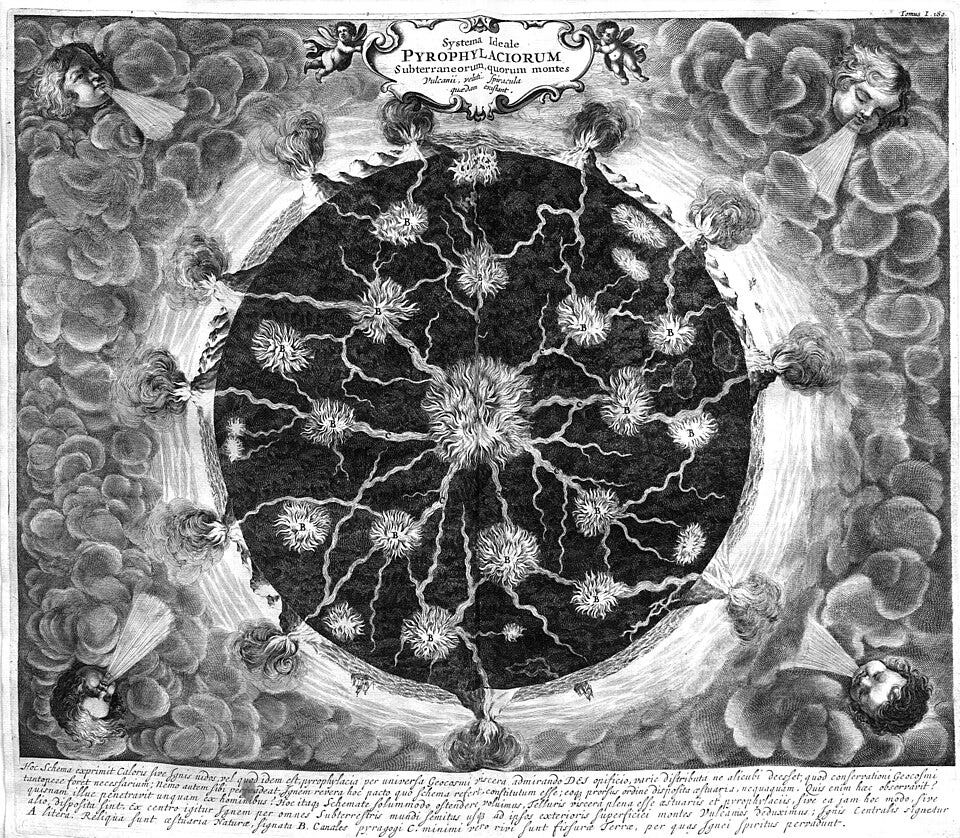
This systemic view of the earth is most vivid in his geological masterpiece, Mundus Subterraneus, published in 1665. Rather than viewing the planet as a collection of stagnant, isolated rocks, Kircher envisioned the Earth as a dynamic, breathing organism sustained by vast, hidden networks of fire and water (Figueirôa, n.d.). His intricate illustrations mapped underground rivers, thermal reservoirs, and oceanic currents as an integrated bodily infrastructure, where every mountain cavern and surface spring played a functional role in balancing the broader biosphere. This early conceptualization directly parallels the modern framework of ecological integralism. Instead of managing a landscape through disconnected administrative silos, Kircher’s subterranean cartography serves as a powerful visual metaphor for a polycentric network, showing how localized, autonomous ecological nodes must continuously exchange resources to maintain the vitality of the entire socio-ecological system.
The structural equilibrium governing these material flows finds its philosophical foundation in Kircher’s 1650 musicological treatise, Musurgia Universalis. Grounded in the classical Quadrivium, Kircher argued, like the Pythagoreans before him, that the entire universe operates according to mathematical proportions and a transcendent, universal harmony (Gouk, 2012). He mapped these harmonic laws across vastly different domains, analyzing everything from the distinct frequencies of bird songs to the mathematical orbits of the planets. Within a theoretical framework that seeks to bridge the individual human person with the broader governance of the community, this work becomes highly significant. By demonstrating that diverse, autonomous elements can achieve a state of resonance when properly tuned to one another, Kircher offers an early blueprint for achieving structural balance in governance. It suggests that a polycentric society can move past rigid, top-down enforcement and instead cultivate a state of equilibrium where local institutions and ecological realities naturally harmonize.
To navigate and manage such an intricate matrix of relationships, Kircher recognized the need for a shared method of communication, which he attempted to build in his 1669 work, Ars Magna Sciendi. This ambitious project sought to establish a universal symbolic language based on combinatorics, creating an “alphabet of thought” designed to organize all human knowledge into a single, cohesive framework (Trettien, n.d.). In the context of polycentric governance, this combinatorial art provides a vital methodological lesson. It outlines an administrative logic that respects the autonomy of local regions and distinct intellectual disciplines, while still ensuring they remain bound to a universal ethical standard. For modern integral development, this mirrors the challenge of creating communication channels that allow diverse communities to collaborate globally without sacrificing their distinct regional identities or compromising human dignity.
When looking for a concrete example of this systemic balance in practice, Kircher turned to sacred history in his 1675 volume, Arca Noë. Treating Noah’s Ark not merely as a biblical relic but as a highly sophisticated engineering problem, he provided a detailed technical breakdown of the vessel as a self-contained, perfect ecosystem. Kircher meticulously calculated space allocations, dietary requirements, and waste management systems to explain how hundreds of distinct animal species could survive together within a strictly confined space (Cole, 2016). This analysis functions as a proto-model for resilient territorial planning during an ecological crisis. It demonstrates how diverse individuals can be integrated into a functional, multi-layered community, proving that long-term survival relies on decentralized, specialized functions working in tandem under a shared ethos of stewardship.
Conversely, Kircher’s 1679 study, Turris Babel, serves as an explicit warning against the failures of centralized, top-down administration. By examining the architectural hubris and subsequent linguistic fragmentation of the Tower of Babel, he illustrated how large-scale human systems become inherently fragile when they rely on forced, uniform control. When a community loses a shared understanding and mutual respect for communicative dignity, the entire social structure collapses into isolation and fragmentation. For contemporary research into polycentric development, Turris Babel highlights the necessity of open, transparent communication and decentralized networks. It reinforces the idea that true systemic resilience cannot be dictated from above; rather, it must be carefully nurtured from the ground up, ensuring that the dignity of the human person and the integrity of the local ecosystem remain the central focus of governance.
Bibliography
Cole, L. (2016). Imperfect creatures: Vermin, literature, and the sciences of life, 1600-1740. University of Michigan Press. https://doi.org/10.3998/mpub.4424519 Cited by: 153
Figueirôa, S. F. M. (n.d.). History of geological science. Encyclopedia of Life Support Systems (EOLSS). Cited by: 0
Gouk, P. (2012). Music and the emergence of experimental science in early modern Europe. SoundEffects - An Interdisciplinary Journal of Sound and Sound Experience, 2(1), 5–21. https://doi.org/10.7146/se.v2i1.5183 Cited by: 18
Trettien, W. A. (n.d.). Computers, cut-ups and combinatory volvelles: An archaeology of text-generating mechanisms [Doctoral dissertation, Massachusetts Institute of Technology]. DSpace@MIT. Cited by: 8