
Beyond Growth
Refining the UN Roadmap through Polycentric Ecological Integralism

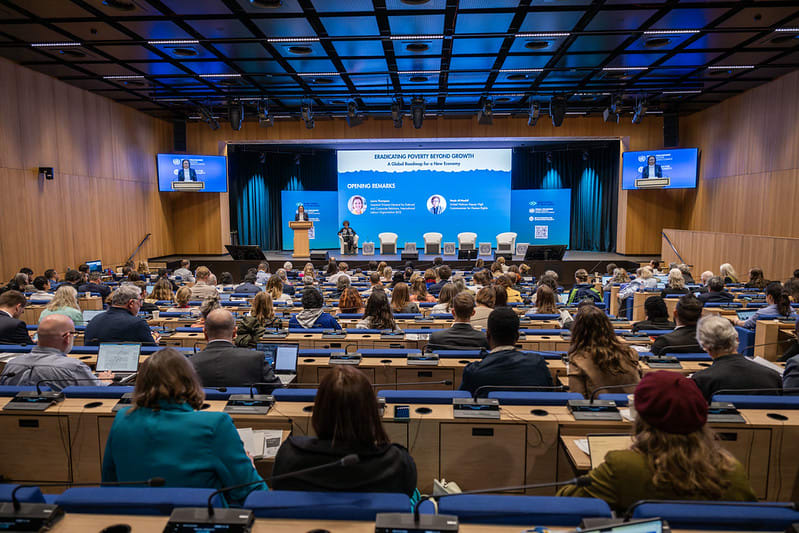
The draft Roadmap for Eradicating Poverty Beyond Growth—developed under the New Economies for Eradicating Poverty (NEEP) initiative—represents a significant shift from the traditional growth and redistribution model toward a “human rights economy.”
Analyzing the five pillars of the UN draft through the lens of polycentric ecological integralism reveals both strong alignments and opportunities to further refine the administrative logic into a truly ecological and integral framework.
1. The Foundation: Human Dignity and Personhood
The Roadmap’s shift toward a human rights economy aligns with the principle that every individual possesses an inherent, indivisible dignity that must be the starting point of any economic system.
Observation: The UN draft proposes universal social protection and income security to eradicate poverty.
Recommendation: To move beyond mere administrative logic, these protections should be viewed as the necessary material base that allows each person to function as a self-actualising member of their community. The goal is not just the provision of services, but the restoration of the person’s agency and standing within the social fabric.
2. Structural Framework: The Polycentric Community
The draft’s multi-level toolbox and focus on governance suggest a move toward decentralised authority, which is essential for a resilient community model.
Observation: The Roadmap prioritises the Social and Solidarity Economy (SSE) and participatory democracy.
Recommendation: Strengthen this by moving from participation to a truly polycentric model. In this framework, the community functions as a self-governing node where the economy and social life are integrated at the territorial level. This ensures that the “human rights economy” is not a top-down mandate but a bottom-up reality managed by the people it serves.
3. Environmental Integration: Territorial Ethics
The Roadmap’s goal to align social justice with planetary wellbeing requires a shift in how we perceive our relationship with the environment.
Observation: Pillar 4 addresses resource management and environmental limits.
Recommendation: Transition from the language of managing resources to territorial ethics. Instead of simply extracting within limits, the community should be structured to maintain and regenerate the local ecology as a fundamental requirement for human development.
4. Morphological Resilience: Localisation vs. Fragility
The Special Rapporteur identifies the current global economy as fragile and prone to inequality.
Observation: The draft suggests wealth redistribution and public employment guarantees to combat systemic poverty.
Recommendation: Focus on pre-distribution and resilience. While redistribution fixes outcomes, a polycentric approach focuses on the morphology of the system—empowering local communities to own and manage productive assets (such as agrotowns). This creates a resilient network of local economies that are less susceptible to global shocks.
5. Methodology: Moving to Symbiotic Lucidity
The transition “beyond growth” requires a new set of metrics that reflect the integral health of both people and the planet.
Observation: The Roadmap seeks indicators that move “Beyond GDP” to monitor progress.
Recommendation: Foster symbiotic lucidity by adopting multidimensional indicators like Gaël Giraud’s Relational Capability Index. These metrics should transition from measuring material output (GDP) to measuring the resilience of the social bond and the health of the territorial commons. By quantifying the quality of our interdependence, we ensure that the “beyond growth” roadmap lead to a society that is not only ecologically sustainable but humanly flourishing.
Final Summary of Refinements:
Subsidiarity: Ensure all economic interventions are applied at the most local level possible to preserve human dignity.
Integralism: Treat poverty not as a lack of income, but as a lack of integration into a supportive, ecological, and social community.
Resilience: Replace fragile, centralised administrative systems with a polycentric network of self-sustaining communities.
The Athenaeum looks forward to the launch of NEEP as the next phase of this collective effort.