
Human Dignity and Polycentric Order
The Cusanian Microcosm

The relationship between the individual as an indivisible unit of dignity and the collective structure of the city-state requires a shift from purely administrative logic towards an ecological and integral development. In the context of the Polycentric Community, this transition is best understood by bridging the metaphysical concept of the monad1 with the structural reality of the polis.2 The human person, viewed as a monad, represents a totality that cannot be reduced to a mere component of a machine, whilst the polis, in its polycentric form, serves as the necessary environment for this dignity to flourish without being absorbed into a monolithic state.
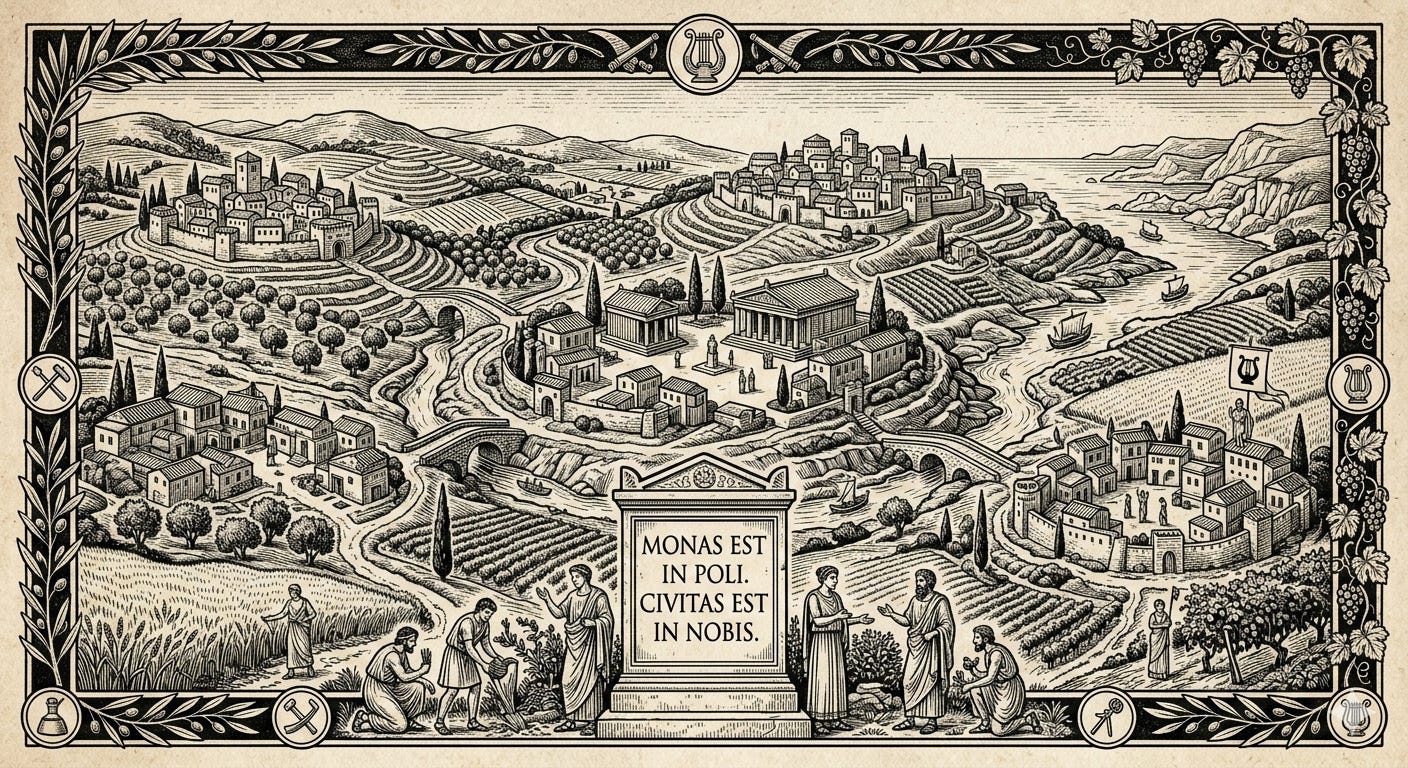
Nicholas of Cusa (a.k.a “Cusanus”) provides a foundational metaphysical layer for this understanding in De Docta Ignorantia. For Cusanus, the universe is a contraction of the infinite, where every part reflects the whole in a unique manner. He posits that the center is everywhere and the circumference nowhere, a concept that aligns perfectly with a polycentric vision of social organization. When the human person is treated as a monad in the Cusanian sense, they are seen as a microcosm possessing an inherent infinity. This metaphysical standing ensures that the person remains the primary subject of development rather than an object of bureaucratic management. The Monad is not isolated but is a node of intense relationality that requires a specific kind of space to manifest its potential.
This space is the polis, but not the polis of modern centralism. It is instead a polycentric arrangement that mirrors the complexity of natural ecosystems. Giambattista Vico, in The New Science, emphasizes that the world of civil society is certainly made by people, and its principles are therefore to be found within the modifications of our own human mind. Vico’s recognition of the historical and poetic nature of human institutions suggests that the polis is a living organism, a product of collective imagination and labour. By rooting the Community in the specific historical and cultural realities of its people, we move away from the sterile, top-down logic that often characterizes modern governance. Vico’s thought supports the idea that the dignity of the person is preserved through the maintenance of these diverse, overlapping centers of life and authority.
The necessity of this rooting is further articulated by Simone Weil in The Need for Roots. Weil argues that to be rooted is perhaps the most important and least recognized need of the human soul. She critiques the uprootedness caused by modern industrial and administrative systems, which treat individuals as fungible units. For Weil, a true community provides the Monad with the spiritual and material nourishment required for integral development. The Polycentric Community acts as a safeguard against the dual threats of individualist isolation and collectivist totalization. It creates a tapestry of belonging where the person can exercise their agency within a scale that remains human and ecologically sensitive.
In contemporary scholarly discourse, this vision is echoed in our work, particularly regarding the historical and resource-based significance of agrotowns.3 Donato (2018) observes that these specific urban-rural configurations represent a unique intersection of human settlement and ecological stewardship. The agrotown serves as a concrete example of a polycentric node where the administrative logic of the distant center is replaced by the immediate needs of the local community and its environment. By examining the history of these settlements, we see a template for a Community that prioritizes the dignity of the person by situating them within a manageable, productive, and culturally rich locale. This is the essence of moving from a system of control to one of cultivation.

The integration of the monad and the polis suggests that human rights-based development must be fundamentally educational and participatory. As noted in the manual From Poverty to Dignity, the focus must remain on the empowerment of the person as a bearer of rights rather than a recipient of charity (Dignity International, 2007). This aligns with the Cusanian idea of the person as a self-folding reflection of the infinite; for a person to realize their dignity, they must be the protagonists of their own development. The Polycentric Community provides the structural diversity necessary for this protagonism to occur across various social, economic, and ecological spheres.
Furthermore, the transition to an ecological framework requires us to view the polis not as a paved enclosure, but as a site of metabolic exchange. The dignity of the person is inextricably linked to the health of the ecology they inhabit. If the monad is the indivisible spark of human life, the polis is the vineyard that sustains it. When the system becomes overly centralized or driven by purely administrative efficiency, it tends to ignore the delicate balances required for both human and environmental flourishing. A polycentric approach allows for local adaptations and diverse solutions to ecological challenges, ensuring that the global Community remains resilient and pluralistic.
Ultimately, the synthesis of these thinkers points toward a model of governance where the monad’s dignity is the absolute starting point. Nicholas of Cusa provides the metaphysical depth, Vico provides the historical and social grounding, and Weil provides the moral urgency of rooting. These ideas, when applied to the structural frameworks discussed in Donato (2018), offer a path forward that transcends the limitations of the modern nation-state. The Polycentric Community becomes a sanctuary for the human person, a space where the monadic nature of the individual and the polycentric nature of the community exist in a state of mutual enhancement. This is not a return to a romanticized past, but a rigorous intellectual and practical movement toward a future where administrative logic finally serves the ends of human and ecological dignity.
Bibliography
Cusanus, N. (1985). De Docta Ignorantia (On Learned Ignorance). Translated by J. Hopkins. Minneapolis: Arthur J. Banning Press. (Original work published 1440).
Dignity International. (2007). From Poverty to Dignity: A Learning Manual on Human Rights-based Development. Edited by D. Donato. Kuala Lumpur: Dignity International.
Donato, D. (2018). Agrotowns, a Brief History and Review of Resources. International Critical Thought, 8(3), pp. 501–506. doi: 10.1080/21598282.2018.1506263.
Vico, G. (1948). The New Science of Giambattista Vico. Translated by T. G. Bergin and M. H. Fisch. Ithaca: Cornell University Press. (Original work published 1744).
Weil, S. (1952). The Need for Roots: Prelude to a Declaration of Duties Towards Mankind. Translated by A. Wills. New York: Putnam. (Original work published 1949).
Monad (from the Greek monas, meaning “unity” or “indivisible unit”): Metaphysically derived from Hermetic sources and Nicholas of Cusa, the term designates the human person as an irreducible microcosm of inherent infinity and sacred dignity, serving as a highly relational node that cannot be subsumed by administrative logic.
Polis: The ancient Greek city-state, here understood not merely as a geographic or administrative entity, but as a self-governing, polycentric community of citizens structured to realize integral development, human dignity, and ecological harmony.
Agrotown: A concentrated urban settlement embedded within a rural landscape, historically distinct for its agrarian workforce, serving within a polycentric network to bridge the urban-rural divide and anchor regional socio-ecological resilience.
Wonderful, I look forward to knowing more about the Polycentric!
Thank you for this beautiful, educational post. It would be so wonderful to replace the administrative top-down logic we are enmeshed in with a policentric way of life.. is there anything like it in the world; if yes, where?