
French Integral Ecology
Toward a Synthesis of the Monad and the Polis

The contemporary French discourse on Integral Ecology (Écologie Intégrale) represents a profound intellectual shift, moving away from mere administrative adjustments toward an ontological reframing of the relationship between humanity, the city, and nature. This movement does not merely analyze environmental degradation; it interrogates the very structure of modernity and proposes an alternative to technical reductionism. At the heart of this debate lies a creative tension between two major intellectual poles: the Lyon School, centered on personal dignity and metaphysics, and the Paris School, focused on systemic transition and political philosophy. The necessary synthesis between the depth of the Monad and the structure of the Polis forms the foundation of an integral vision capable of addressing civilizational fragility through polycentric resilience.
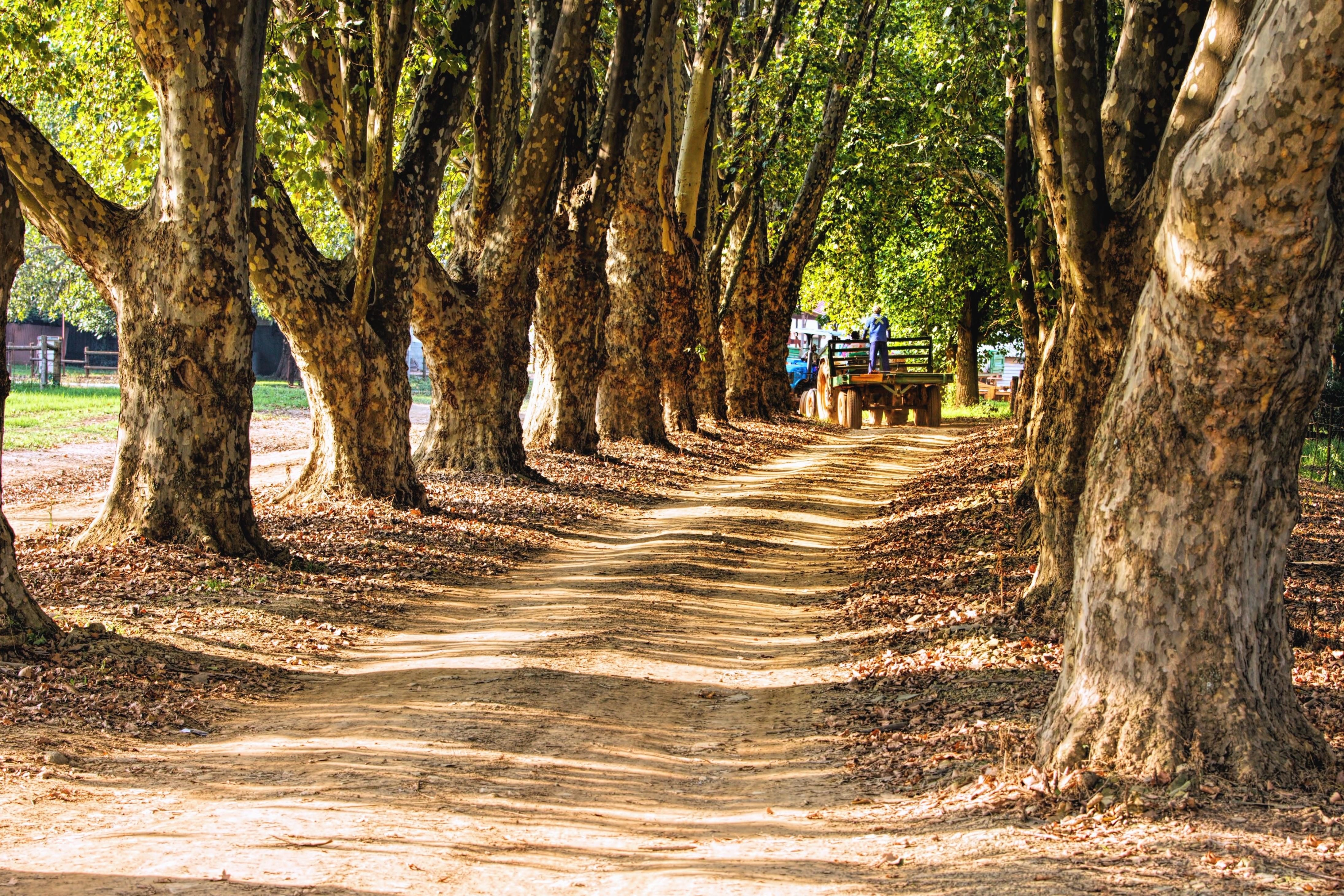
The Lyon School, represented by figures such as Fabien Revol, anchors integral ecology in a genealogy of dignity. For Revol, ecology cannot be dissociated from an understanding of continuous creation. The human person is not perceived as a mere economic agent or a consumer of resources, but as a relational Monad whose intrinsic dignity is the pivot of any social order (Revol, 2017). This approach draws from personalist sources to affirm that the ecological crisis is, above all, a crisis of meaning and being. The Monad, far from being an isolated atom, becomes the locus of an ontological responsibility toward the living. Revol argues that the integrity of an ecosystem is incomplete if it does not recognize the sacred dimension of every individual within it (Revol, 2020). This framework allows for a transition from a logic of domination to a logic of partnership with the natural world, perceived not as an inert object but as a sanctuary or a “vineyard” in the making, a concept deeply rooted in the “Paschal Ecology” of Jean Bastaire (Bastaire, 2004).
In contrast, yet in a complementary fashion, the Paris School, illustrated by Dominique Bourg, approaches ecology through the lens of transition and systems reform. Here, the emphasis is placed on the Polis as a structure of governance and regulation. Bourg advocates for a “perma-circular” society, where planetary boundaries dictate the frameworks of democratic deliberation (Bourg and Roch, 2017). This approach is more systemic, seeking to transform the administrative logic of the state to make it compatible with the finitude of resources. The fragility of centralized structures is criticized here in favor of more participatory and resilient models (Bourg and Papaux, 2015). The challenge consists of reinventing law and economy so that the city is no longer a machine for extracting value, but an organism capable of regenerating itself. The Parisian Polis is thus one of institutional engineering put at the service of collective survival.
The figure of Gaël Giraud emerges as an indispensable mediator between these two currents. As both an economist and a theologian, Giraud succeeds in translating the metaphysical imperatives of human dignity into technical and mathematical data. He demonstrates that the financialization of the economy, by treating humans and nature as mere adjustment variables, inevitably leads to dehumanization and ecological destruction (Giraud, 2015). Giraud proposes a political economy of the Commons, where vital resources such as water and energy are managed not as private commodities or state-owned assets, but as a shared sanctuary (Giraud, 2022). This model perfectly aligns the ontological dignity of the Lyon School with the systemic rigor of the Paris School. By placing “relational capability” at the center of economic measurement, Giraud provides the “connective tissue” that allows the Monad to function as the active, dignified cell of a resilient, Polycentric Polis.
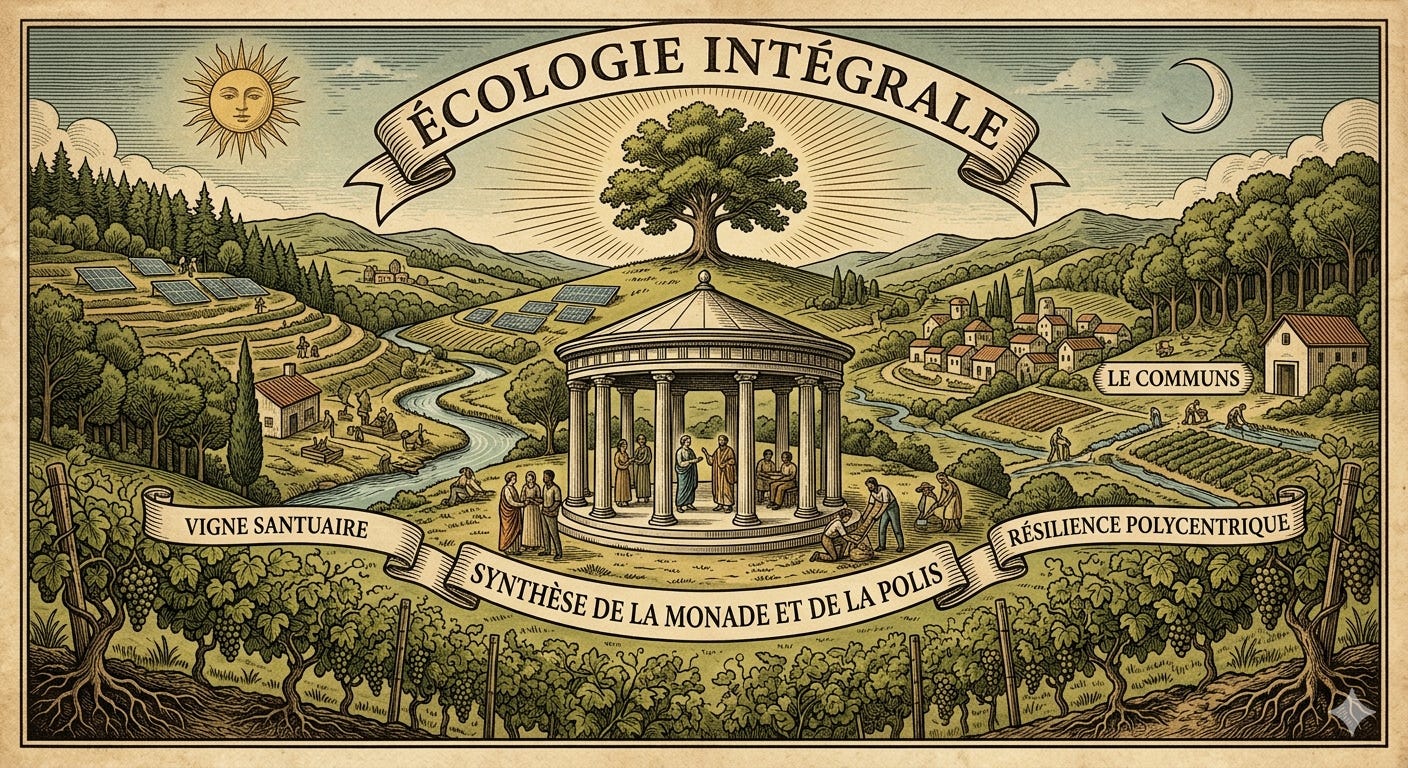
Ultimately, French Integral Ecology teaches us that resilience is found at the intersection of local ethics and systemic rules. A system remains fragile if it is purely administrative or purely spiritual. It becomes resilient when it adopts a polycentric structure—one that respects the indivisible dignity of the person while maintaining a cohesive, ecological whole. This transition from “administrative logic” to “integral development” requires a multi-level governance where the Monad is not swallowed by the state, but protected by it. The future of the Polycentric Community depends on this synthesis, ensuring that the material world is treated as a vineyard to be tended, where every person finds their place in a flourishing, interconnected ecology (Donato, 2018).
Bibliography and further reading
Bastaire, J. (2004) Le chant des créatures : Les racines de l’écologie chrétienne. Paris: Cerf.
Bourg, D. and Papaux, A. (2015) Dictionnaire de la pensée écologique. Paris: Presses Universitaires de France.
Bourg, D. and Roch, P. (2017) Écologie intégrale : Pour une société permacirculaire. Paris: Éditions du Seuil.
Donato, D. (2018) ‘Agrotowns, a Brief History and Review of Resources’, International Critical Thought, 8(3), pp. 501–506. doi: 10.1080/21598282.2018.1506263.
Giraud, G. (2015) L’illusion financière : Des subprimes à la transition écologique. Paris: Éditions de l’Atelier.
Giraud, G. (2022) Composer un monde en commun : Une théologie politique de l’anthropocène. Paris: Éditions du Seuil.
Lasida, E. (2011) L’économie à l’épreuve de l’Évangile. Paris: Bayard.
Revol, F. (2017) Penser l’écologie intégrale. Lyon: Parole et Silence.
Revol, F. (2020) ‘The Concept of Continuous Creation’, Zygon: Journal of Religion and Science, 55(1), pp. 114–132.
Gorgeous photo, helping to visualize, in a sensual way, the harmony that can be achieved between the Monad and the Polis !