
Giambattista Vico
The Architect of Integral Ecology

Abstract
This essay examines how the philosophical framework of Giambattista Vico’s New Science can subvert the rigid, technocratic paradigm of modern administrative logic to foster a model of integral ecology.1 By bridging the metaphysical dignity of the individual (the monad) with a decentralized social architecture (the Polycentric Community), the study demonstrates how Vico’s core principles provide a vital alternative to top-down bureaucratic optimization. Specifically, it analyzes Vico’s epistemological axiom of verum factum as a baseline defense of human agency, his concept of poetic wisdom (sapienza poetica) as a foundation for localized, bioregional institutional design, and his cyclical ideal eternal history (storia ideale eterna) as a model for systemic resilience and organic renewal. Ultimately, the essay argues that transitioning to a sustainable, integral social order requires abandoning the illusion of society as a mechanical instrument, reclaiming governance instead as a localized, continuous act of cultural and ecological creation.
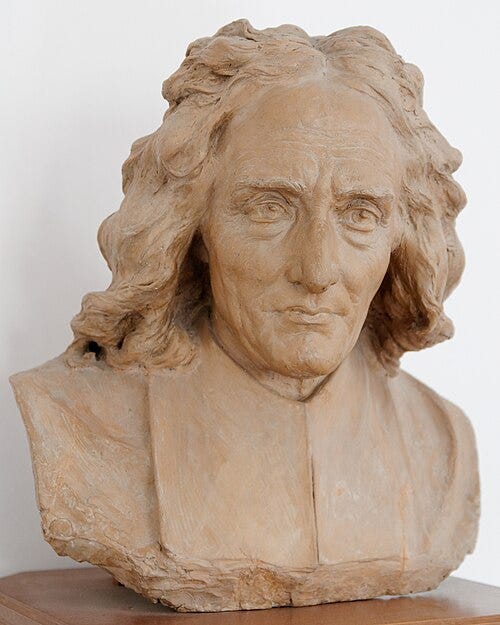
Long before anyone else dared to question the supremacy of cold, hard logic, Giambattista Vico (1668–1744) was throwing shade at the scientific revolution. While his contemporaries were swooning over René Descartes and trying to reduce the human experience to neat mathematical formulas, this Italian philosopher and jurist basically told them to get real.
Vico argued that rigid rationalism was completely impractical for understanding the messy, unpredictable nature of human life. Instead, he championed the vibrant world of the humanities, classical history, and the power of symbols—accidentally inventing the foundations of social science and semiotics along the way. As one of history’s first true Counter-Enlightenment rebels, Vico proved that we are shaped by the stories we tell, not just the equations we calculate.
The modern administrative state operates under the comfortable illusion that human society is a complex machine, a giant Swiss watch that can be perfectly tuned if we only employ enough technocrats, spreadsheets, and rigid regulations. This mechanical worldview reduces the city to a collection of cold, interchangeable parts, replacing the vibrant life of the community with a bloodless bureaucratic stasis. To break free from this trap and transition toward an ecological integralism, a framework is required that bridges the absolute, indivisible dignity of the human person, the monad, with a flexible, decentralized social architecture, the Polycentric Community. While modern political theorists offer little help in this endeavor, an unexpected and remarkably witty guide can be found in eighteenth-century Naples. Giambattista Vico, in his masterpiece New Science, provides precisely the philosophical tools needed to dismantle sterile administrative logic and rebuild a social order rooted in human agency and ecological harmony.
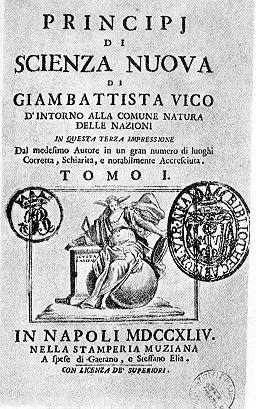
Vico begins his project with a radical epistemological challenge that serves as a foundational defense of human dignity. In his famous formulation of the relationship between truth and making, he asserts that we can truly know only that which we ourselves have constructed (p. 118). While the natural world remains the domain of divine understanding, the world of nations, institutions, and cultures is entirely an artifact of human action (p. 119). This insight delivers a devastating blow to the technocratic assumption that human societies should be governed by abstract, mathematical laws imposed from above. Instead, Vico returns agency to the individual, establishing that the social world is authored by the collective imagination and will of its participants (p. 121). Within a polycentric architecture, this principle transforms the concept of the individual from a passive administrative unit into an active co-creator of the social reality. The dignity of the person is not granted by a centralized authority or protected by a distant legal framework; it is an inherent, ontological reality that expresses itself through the active creation and maintenance of local institutions.
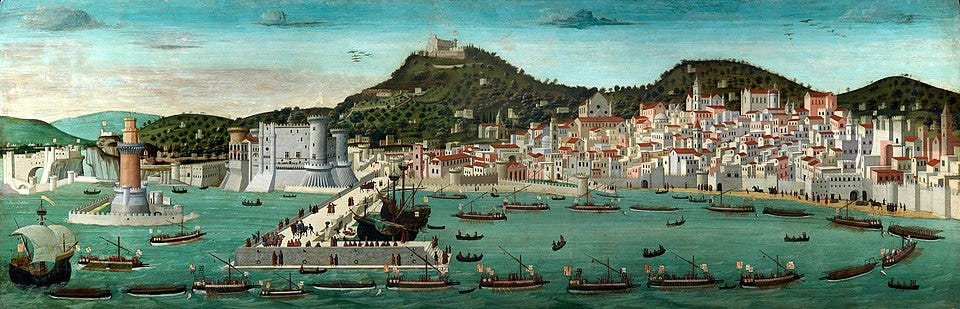
To understand how these institutions are formed without falling back into the trap of bureaucratic planning, we must look to Vico’s concept of poetic wisdom. Long before human beings developed the capacity for abstract, rationalized legal theory, they understood the world through myth, metaphor, and a deep, imaginative connection to their physical environment (p. 145). Vico demonstrates that the earliest laws and social structures were not drafted by committees of specialized lawyers, but were instead forged through a poetic logic that emerged directly from a community’s shared experiences and its relationship with the land (p. 152). This poetic wisdom means that a living commonwealth cannot be constructed using a single, homogeneous template stamped across diverse landscapes. It requires a decentralized, polycentric network where each local community can develop its own institutional expressions based on its unique cultural narratives, historical memory, and geographical realities (p. 160). By anchoring governance in this imaginative and localized wisdom, the commonwealth protects itself from the fragile monotony of the modern state, replacing it with a resilient, pluralistic tapestry of self-organizing communities.
This approach is inherently ecological, viewing the development of human societies not as a straight line of mechanical progress, but as an organic process of growth, maturity, and renewal. Vico describes an ideal eternal history, a grand pattern of cycles through which all nations naturally pass (p. 125). He tracks the movement of societies from an age of gods, where humanity is governed by religious fear and poetic myths, through an age of heroes characterized by aristocratic pride, and finally to an age of men, where abstract reason and legal equality prevail (p. 382). Yet, Vico warns with a touch of dry irony that this final age often overreaches, degenerating into a barbarism of reflection where over-rationalization breeds hyper-individualism, selfishness, and social decay (p. 491). When a civilization becomes so sophisticated that its citizens look at everything through the lens of cold utility, its institutions collapse under the weight of their own artificiality. This cyclical understanding of history encourages us to design institutions that mimic the resilience of natural ecosystems, recognizing that true sustainability requires a capacity for constant adaptation, decay, and rebirth.
When the centralized, overly rationalized administrative structures of the modern world inevitably fracture under their own rigid weight, Vico does not leave us in despair. In his discussion of the recurrence of human things, he explains how societies can rediscover their vital energies by returning to their foundational principles (p. 493). This historical recurrence demonstrates that when a top-down system breaks down, human beings naturally fall back on the core relationships that sustained them in the first place, namely, their local communities, their shared creative imagination, and their relationship with the soil (p. 495). The Polycentric Community is designed to anticipate this reality, creating a decentralized architecture that allows for localized collapse and renewal without threatening the stability of the entire planetary network. It replaces a fragile, centralized hegemony with an interconnected ecosystem of bioregions, each capable of self-repair and independent regeneration.
By integrating Vico’s profound insights into our contemporary framework, we can move decisively past the limitations of modern administrative logic. He offers a vision where the individual monad retains its full, creative dignity, and where the polis functions as an organic extension of human imagination and natural law. Vico reminds us that the quest for a just and ecological society is not a technical problem to be solved by administrative experts, but a continuous act of poetic creation. In an era deeply terrified of ecological collapse and institutional decay, this eighteenth-century Neapolitan rhetorician provides a remarkably fresh perspective, showing us that the path to a sustainable future lies in reclaiming our roles as the true authors of our history, grounded in the dignity of our nature and the living sanctuary of our shared earth.
Bibliography
Vico, Giambattista. The New Science. Translated and edited by Jason Taylor and Robert C. Miner. Introduction by Giuseppe Mazzotta. New Haven: Yale University Press, 2020.
Integral ecology is a holistic framework asserting that environmental sustainability is inseparable from human dignity, social justice, and institutional health. Rather than treating ecological conservation and human development as distinct crises, it conceptualizes them as interconnected dimensions of a single, systemic reality. Under this approach, the preservation of natural ecosystems directly depends on, and supports, the ethical, social, and material well-being of the human person within the community.
Rhe cyclical pattern (ages rising through poetic myth into heroic pride into rational equality, then curdling into a barbarism of reflection before recurrence begins again) is the same shape I keep finding in physical systems too: order accumulating, over-refining itself past what it can sustain, collapsing, and reorganizing from something closer to the root. Vico's warning about a civilization becoming so purely rational that everything gets filtered through cold utility isn't really a political claim so much as a description of what happens to any system that optimizes one function at the expense of the flexibility that let it grow in the first place.