
The Wealth Map
Cataloging Community Wealth

To launch a Polycentric Community Hub, we move from the philosophy of “looking outward” to the rigorous practice of auditing. The Wealth Map is the foundational tool for this—it treats your local community not as a collection of consumers, but as a latent ecosystem of production.
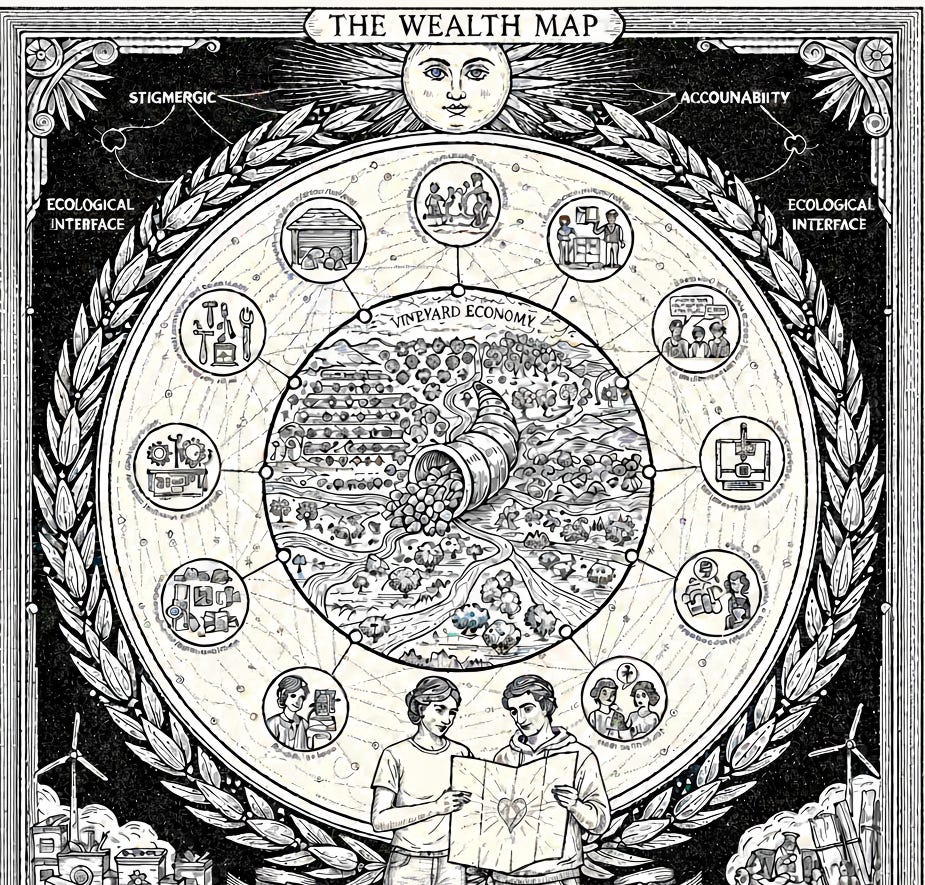
Here is a practical framework for the first phase of the Wealth Map:
The Wealth Map: Phase I (The Local Audit)
This audit is designed to be conducted within a small circle (5–10 people) to identify what is currently sitting idle and ready for activation.
1. The Inventory of Latent Hardware
Instead of individual ownership, we look at Resource Sovereignty. What tools are being underutilized?
Production Tools: Woodworking equipment, 3D printers, sewing machines, or high-end culinary tools.
Infrastructure: Garages that can serve as workshops, spare rooms for server hosting, or garden space for food production.
Transportation: Vehicles capable of hauling goods or specialized machinery for local logistics.
Access a PDF of this worksheet below:

2. The Skills Registry (Professional & Practical)
We map expertise as a circulating asset.
The “Guild” Skills: Electrical work, plumbing, regenerative agriculture, or mechanical repair.
The “Protocol” Skills: Accounting, coding for shared ledgers, medical training, or conflict mediation.
The “Shadow” Skills: Skills people have but don’t use in their day jobs (e.g., an IT professional who is an expert in preserving food).
3. Expertise Registry
List skills that contribute to Resource Sovereignty. Focus on what you can do, not just your job title.
Maintenance & Repair: (Can you fix an engine? Patch a roof? Solder a circuit?)
Skills: _____________________________________________________
Life Support & Ecology: (Can you preserve food? Filter water? Manage a beehive?)
Skills: _____________________________________________________
Organization & Safety: (Can you manage a shared ledger? Provide first aid? Mediate a dispute?)
Skills: _____________________________________________________
3. Mapping the Ecology
A hub must be grounded in its local environment to ensure long-term resilience.
Primary Inputs: Local water sources, solar/wind potential, and soil quality.
Waste Streams: Identifying waste from local businesses that can be reclaimed as wealth for the hub (e.g., wood scraps for heating, organic waste for compost).
Establishing the Ledger
Once the audit is complete, the data is placed on a Shared Ledger. This isn’t a bank account; it’s a transparency tool.
Function: It allows every member of the hub to see what is available for use under the “usufruct” principle (use it, maintain it, don’t diminish it).
Dignity through Agency: By seeing the collective wealth on the map, members move from a state of scarcity (depending on a distant employer) to a state of agency (knowing exactly what they can produce together).
Protocol for the Shared Ledger
Once these forms are filled, the data should be entered into a Shared Ledger accessible to all Hub members.
The Rule of Usufruct: > “I have the right to access the tools and skills of the Hub to provide for my household and the community, provided I maintain the tools I use and contribute my own expertise to the collective flow.”
Why This Matters for Human Dignity
By filling out this map, you are effectively hollowing out the power of both the state and the plutocrat. When you know where your energy, food, and repairs come from locally, you are no longer a “target for capture.” You are a node in a resilient, self-governing architecture.