
Play as Governance
Ritual Protocols for a Living Community

The history of human cooperation is often written in the dry ink of ledgers and the cold stone of legislation, but if we wish to understand how a group actually breathes, we must look to the mask, the feast, and the game. We have spent centuries attempting to organize ourselves as if we were particularly dull spreadsheets, yet we wonder why our grand social experiments so often collapse into the gravitational pull of hierarchy or the entropy of boredom. Our goal requires a comprehensive social architecture of dignity, and it acknowledges that to make a system work, you must first make it worthy of the human spirit.
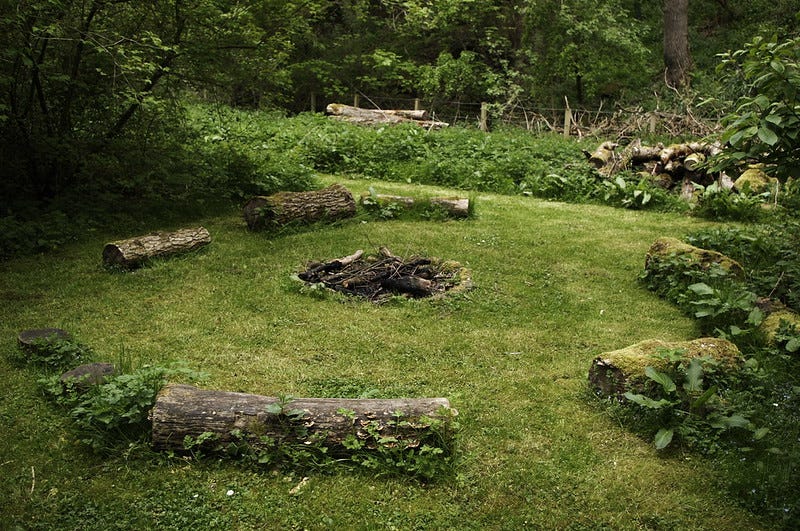
The missing element is not more administrative logic but the recovery of the magic circle, that sacred space of play where the rigid structures of class and status are suspended long enough for us to remember how to be human together. As Umberto Eco noted, the symbol is not merely a sign but a doorway to a forest of meanings where the literal mind goes to lose its chains (Eco, 1984), and it is through this symbolic play that a community moves from a chore of survival to a sanctuary of flourishing.
The psychological foundation of any lasting polycentric system is the ability to temporarily step out of one’s inherited skin. When Thespis first stepped away from the dithyrambic chorus, he did not merely invent acting; he inaugurated the protocol of rotation. By donning the mask, he ceased to be a singular citizen bound by his specific debts or social standing and became a vessel for a communal truth. This is the primordial root of what we might call sacred lucidity, a state of awareness that is both ecstatically connected to the group and intellectually sharp enough to manage its complexity. In our modern attempts at mutual aid, we must replicate this theatrical leap. If we cannot role-play a scenario where power is shared or shifted in a low-stakes environment, we will never possess the neural pathways required to do it when the stakes are high.
Consider the act of joining a community, which we too often treat as a clerical burden involving the signing of many tedious forms. In a true community, the placement of one’s first signal on a wealth map should be a communal rite of initiation. One might imagine a shared meal where a new member announces their signal, describing the specific skill or tool they are placing into the common while the group acknowledges it with a traditional refrain. This is not mere window dressing. As Simone Weil observed, the need for roots is perhaps the most important and least recognized need of the human soul (Weil, 1952), and such a rite turns resource sharing into a covenant of mutual aid. It transforms the individual from a customer of a service into a vital organ of a living body, a transition that requires the gravity of ritual to stick to the ribs of the psyche.
To prevent the creeping rot of soft centralization, where the same three people end up making every decision because they are the only ones who know where the metaphorical keys are kept, we must employ the great rotation game. Once a quarter, a circle should hold a shadow meeting where members draw lots to switch roles. The accountant becomes the gardener; the most soft-spoken member is tasked with facilitation. This is not just a lark; it is a stress test for governance. It reveals hidden dependencies and reminds the circle that everyone is capable of holding the center. By forcing us to don the mask of the other, we dissolve the ego and prevent the role of leader from becoming a permanent identity. It is a practical application of Nicholas of Cusa’s coincidence of opposites, where the part and the whole find their equilibrium through constant, playful movement (Cusa, 1985).
This movement must also be synchronized with the world outside the human ledger. We are currently trapped in corporate time, a linear march of quarters and fiscal years that has nothing to do with the soil or the soul. To reclaim what we might call our species being, a community should establish polytemporal feasts marked by local ecological milestones rather than the Gregorian calendar. The return of a specific bird or the first frost becomes the signal to stop and celebrate. This pulls the group out of the abstract vacuum of global capital and re-grounds them in a specific ecology. It is an act of resistance against the alienation described by Frere Dupont, creating a sanctuary where the work of management stops being a task and begins to resemble the rhythms of a vineyard (Dupont, 2007).
The ledger itself, that great engine of modern anxiety, requires its own seasonal cleansing. If we are to avoid the traps of the old financial system, we must periodically hold a symbolic burning of the debts. Once a year, the circle should destroy or reset the representations of what is owed, reinforcing the idea that the ledger is a tool for coordination, not a mechanism for bondage. This is the gift economy asserting its dominance over the transaction. It acknowledges that in a truly polycentric system, the health of the whole is the only real security for the part. As Elinor Ostrom demonstrated in her work on the commons, the most successful systems are those that are monitored and governed by the participants themselves through clear, shared norms (Ostrom, 1990). Adding a layer of ritual to these norms ensures they are not just followed but loved.
When conflicts arise, as they inevitably do when more than two humans gather in a room, we should turn to stigmergic theatre rather than dry debate. Instead of arguing in circles, members can physically act out the signals of the problem. One person represents the need, another the resource, and a third the obstacle. By moving through physical space to represent these forces, the group can see a solution through a different dimension of understanding. It moves the conflict beyond the binary of either/or and into the realm of creative emergence. This is the social architecture of dignity in action, acknowledging that we are more than just rational actors; we are embodied beings who learn through movement and metaphor.
This approach reconciles the technical proficiency of stigmergic signaling with the human need for meaning. We are proposing a society that is technically proficient, ecologically attuned, and psychologically whole. Giambattista Vico reminded us that humans only truly understand what they have themselves created (Vico, 1948), and by treating the community as a shared play, we ensure that every member is a co-creator of the social fabric. The ledger becomes the script, the protocols of rotation become the changing of the masks, and the community itself becomes a source of profound human flourishing. We are moving beyond the mere question of how we survive a crumbling world and into the much more interesting territory of how we might actually live within it. By reintroducing the psychology of play, we invite everyone to step out of the chorus of the alienated and, like the first actor, take up a role that is both deeply personal and essentially communal.
Bibliography
Cusa, N. (1985). On Learned Ignorance (J. Hopkins, Trans.). Arthur J. Banning Press.
Dupont, F. (2007). Species Being and Other Stories. Ardent Press.
Eco, U. (1984). Semiotics and the Philosophy of Language. Indiana University Press.
Giraud, G. (2013). Illusion Financière. Éditions de l’Atelier.
Ostrom, E. (1990). Governing the Commons: The Evolution of Institutions for Collective Action. Cambridge University Press.
Vico, G. (1948). The New Science (T. G. Bergin & M. H. Fisch, Trans.). Cornell University Press.
Weil, S. (1952). The Need for Roots: Prelude to a Declaration of Duties Towards Mankind. Routledge.
This is profound, and wonderful🌹