
You Cannot Storm a Cloud
Why the Winter Palace Model Fails in the Age of Techno-Feudalism


Leninism succeeded as a machine of rapid modernization, utilizing the state to forcibly compress centuries of development into decades. According to data from the 1926 and 1939 Soviet censuses, the regime achieved unprecedented leaps in literacy and life expectancy, effectively universalizing primary medical care and providing a floor for human material survival that Czarist semi-feudalism could not sustain.
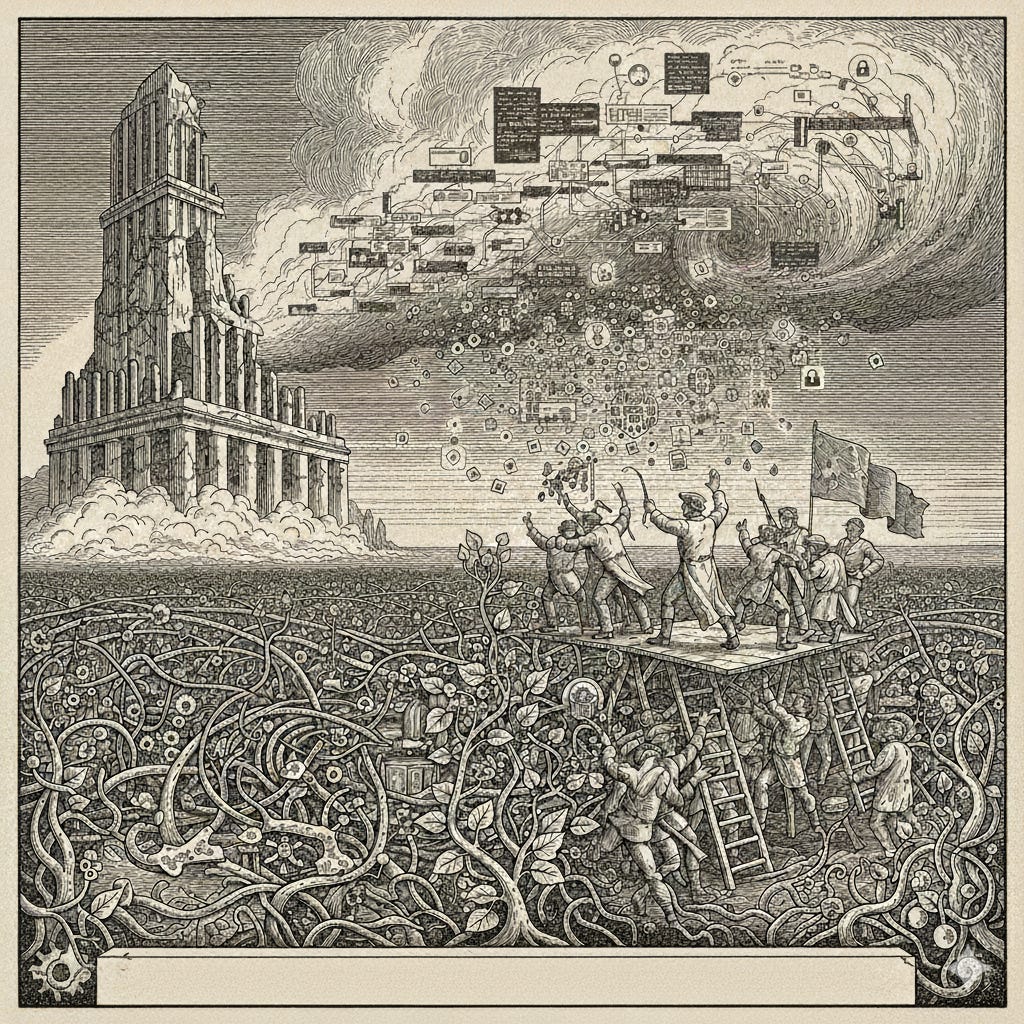
However, the foundational problem lies in the Vanguard Party structure defined in What Is to Be Done?, which replaced the spontaneity of the masses with a rigid hierarchy. This structural artifice necessitated the paranoia of the Great Purge and the ossification of the Central Committee into a gerontocratic echo chamber. The dictatorship of the proletariat inevitably devolved into the dictatorship of the Party over the proletariat, often sliding into the dynastic necro-politics seen in the Kim or Ceaușescu regimes. In the contemporary landscape of atomized digital labor and what Yanis Varoufakis identifies as Techno-Feudalism, the Leninist model of seizing physical means of production is obsolete; one cannot storm the Winter Palace of a cloud-based algorithm.
The Polycentric Commonwealth offers the necessary corrective by replacing monolithic centralism with a distributed ecology of power that preserves the dignity of the human person. This framework allows for a nuanced integration of the metabolic rift identified by Witold Kula, whose analysis of the pre-capitalist feudal system provides the essential bridge to understanding how the rent-seeking extraction of modern platforms mirrors the rigid structures we seek to transcend.
In the transition from the industrial era to the era of algorithmic extraction, the traditional Leninist framework reveals itself as both a miracle of rapid material advancement and a cautionary tale of structural ossification. To understand the Polycentric Commonwealth as a viable alternative to contemporary Techno-Feudalism, one must first dismantle the machinery of the vanguard party while acknowledging its historical utility in addressing the material crises of the early twentieth century.
The Successes of the Vanguard Machine
Leninism was, at its core, an emergency response to the collapse of the Russian Empire and the failures of global capitalism during the First World War. The primary sources of the era, most notably the reports from the First All-Russian Congress of Soviets and the early decrees of the Council of People’s Commissars, highlight an immediate commitment to the “liquidation of illiteracy.” This program, known as Likbez, was not merely an educational initiative but a foundational requirement for the dignity of the human person within a modernizing state. Between the 1920s and late 1930s, literacy rates in the Soviet Union jumped from roughly 24% to nearly 90%, a feat unparalleled in Western liberal democracies during the same time-frame.
Furthermore, the Commissariat for Health, established in 1918, pioneered a socialized medical system that effectively eradicated cholera and typhus epidemics within its first decade. This “Semashko system” provided a blueprint for universal healthcare that raised life expectancy and lowered infant mortality rates with a speed that contemporary scholars of development still study as a model of centralized efficacy. For the rural peasant, the transition from the feudal mir to a collectivized industrial economy represented a literal movement out of the mud and into a world of electricity, antibiotics, and formal education.
The Pathology of Centralism
However, the architecture of this success contained the seeds of its own decay. As Vladimir Lenin outlined in What Is to Be Done?, the revolution required a vanguard of professional revolutionaries to guide the proletariat, whom he believed were only capable of achieving “trade-union consciousness” on their own. This foundational distrust of spontaneous social organization created an artifice of monolithic ideology. Once the vanguard seized the state, the dictatorship of the proletariat described in The State and Revolution quickly transitioned into a dictatorship of the Party over the proletariat. I have witnessed this dynamic firsthand both in Eastern Europe and in Communist and Workers’ parties around the world.
The primary problem of this model is its inherent paranoia. Without a polycentric distribution of power, the center views any deviation from the official line as an existential threat. This led to the tragic purges of the 1930s and the establishment of an echo chamber where truth and honest analysis was sacrificed for ideological purity. By the mid-twentieth century, this system had ossified into the gerontocracy of the Brezhnev era and the dynastic absurdities of Nicolae Ceaușescu’s Romania or the Kim dynasty in the DPRK. These regimes illustrate the ultimate failure–not of socialism or communism–but of monolithic centralism: a system that claims to represent the future becomes a museum of the past, run by a narrow elite who are insulated from the social and ecological realities they claim to manage.
The Shift to Techno-Feudalism
Today, the Leninist model of the Winter Palace—a central point of power to be seized—is fundamentally obsolete. We have entered what Yanis Varoufakis describes as “Techno-Feudalism,” a state where capital has been replaced by “cloud-capital.” In this paradigm, labor is no longer centralized in factories but atomized across digital platforms. The “rent” extracted by these platforms—Amazon, Google, Meta—functions less like modern capitalism and more like the feudal systems described by Witold Kula in An Economic Theory of the Feudal System.
Kula’s analysis of the Polish feudal economy highlights a “metabolic rift” where the center (the lord) extracts surplus without reinvesting in the productivity of the land or the laborer. In Techno-Feudalism, the digital serf provides data and labor to the platform-lord, who extracts value through algorithmic rent. The old Leninist solution—the nationalization of industry—cannot solve this because cloud-capital is borderless and intangible. Seizing the physical hardware does not seize the algorithm.
The Polycentric Commonwealth as the Solution
The Polycentric Commonwealth emerges as the necessary evolution of both the failed centralism of the twentieth century and the predatory extraction of the twenty-first. It abandons the “vanguard” in favor of a distributed ecology of power that prioritizes the dignity of the person and the health of the environment. Unlike the monolithic party, the Commonwealth operates through overlapping circles of authority, ensuring that no single “center” can become an echo chamber for a ruling elite.
By integrating Witold Kula’s insights into the non-capitalist nature of feudal extraction, the Commonwealth recognizes that our current struggle is not just against “capital” but against a return to “rent.” We must build a system where the vineyard of human society is managed not for the extraction of algorithmic rent but for the flourishing of the human person. This requires a symbolic literacy that understands desire and labor as part of a cosmic flow, rather than as data points to be harvested by a digital sovereign.
To participate in the construction of the Polycentric Commonwealth, one must first transition from the role of a passive data-provider to that of an active steward of the social and ecological vineyard. The building of this system does not require a singular, violent rupture, but rather a persistent and distributed series of transvaluations in how we treat labor, digital space, and the dignity of our peers.
Cultivating Symbolic Literacy
The first step is the recovery of symbolic literacy. We must reject the reduction of the human person to a demographic category or a set of consumer preferences. By viewing our identities and desires as structural operators—forces that can destabilize rigid hierarchies and open up new ways of being—we resist the flattening effects of both monolithic ideology and algorithmic control. Read deeply into the mythic and historical grammars that modernity has attempted to simplify, and apply that complexity to your daily interactions.
Practicing Decentered Stewardship
In your professional and social life, look for opportunities to replace centralized hierarchies with polycentric networks. This means supporting cooperative economic models, decentralized digital protocols, and local ecological initiatives that prioritize the health of the land over the extraction of rent. When you engage with technology, do so as a critic and a creator rather than a tenant. The goal is to atrophy the power of cloud-capital by building parallel systems of mutual aid and local governance that do not rely on the extraction of “algorithmic rent” for their survival.
Honoring the Metabolic Balance
Finally, we must address the metabolic rift identified by Kula. This requires a radical commitment to our ecology. We must advocate for and implement economic practices that reinvest surplus back into the land—both literal and metaphorical. Whether through supporting regenerative agriculture or fighting for the right to repair and own our digital tools, we must ensure that the flow of our labor sustains the community rather than accumulating in the coffers of a new feudal elite.
By engaging in these practices, you move from being a digital serf toward becoming a free participant in a Commonwealth that honors the sanctity of the person and the permanence of the earth.
Bibliography
Kula, Witold. An Economic Theory of the Feudal System: Towards a Model of the Polish Economy 1500–1800. Translated by Lawrence Garner, NLB, 1976.
Lenin, Vladimir I. The State and Revolution: The Marxist Theory of the State and the Tasks of the Proletariat in the Revolution. 1917. International Publishers, 1932.
---. What Is to Be Done? Burning Questions of Our Movement. 1902. Translated by Joe Fineberg and George Hanna, International Publishers, 1969.
Varoufakis, Yanis. Technofeudalism: What Killed Capitalism. Melville House, 2023.